Ellipses and Elliptical Orbits
What is an ellipse?
Technical definiton of ellipse: for any point on the ellipse, the sum of distances to each focus is constant.
See labelled diagram for an ellipse below for the names of the different components.
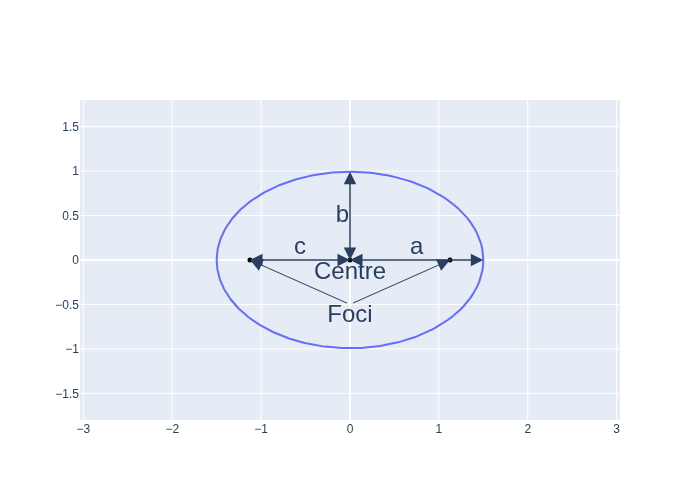
- Semi-major axis, $a$
- Semi-minor axis, $b$
- Distance from centre to focus, $c$
The distance from centre to focus, $c$ is geometrically related to the semi-major and -minor axes by the equation:
\[c^2 = a^2 - b^2 \tag{1}\]Here we can define a new term - the eccentricty $e$ - which is related to $c$ and $a$ by:
\[c = a e \tag{2}\]When $e=0$, then the ellipse is a special case - a circle. Ellipses have eccentricities $0 \leq e < 1$. Where $e=1$, the ellipse is now unbound and becomes a parabola, and where $e>1$ the eccentricity is so extreme that we refer to the curve as a hyperbola.
Elliptical orbits
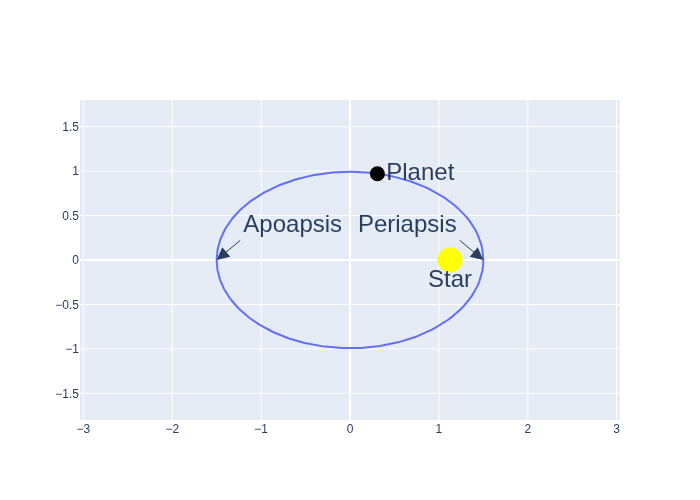
Planet’s have elliptical orbits around their star, which is found at one of the focus points. Technically, both the star and planet have elliptical orbits around the system’s centre of mass, which is found at the shared focus of every elliptical orbit of each object in the system. Understanding this is important for understanding other methods for detecting exoplanets, such as the Doppler Method. But for our purposes, the star’s mass is usually so much greater than the plantary mass, and the star’s orbit so much smaller in comparison to the planet’s orbit, that it is helpful for us to simplify and imagine that the star is fixed at the focus point of a planet’s elliptical orbit around it.
The point on the orbit where the planet is closest to its star is called the periapsis, or when the star is the Sun, it is called the perihelion. The opposite point, where it is furthest from its star, is called the apoapsis, or when the star is the Sun, it is called the aphelion.
Anomalies and Kepler’s Second Law
Kepler’s Second Law states that a line from an object on an elliptical orbit to the star at one of its focal points will sweep out equal areas during equal intervals in time. This basically means that an object moves faster when its closer to its star and slower when its further away.
In order to accurately animate orbital motion with Kepler’s Second Law, we must understand elliptical anomalies.
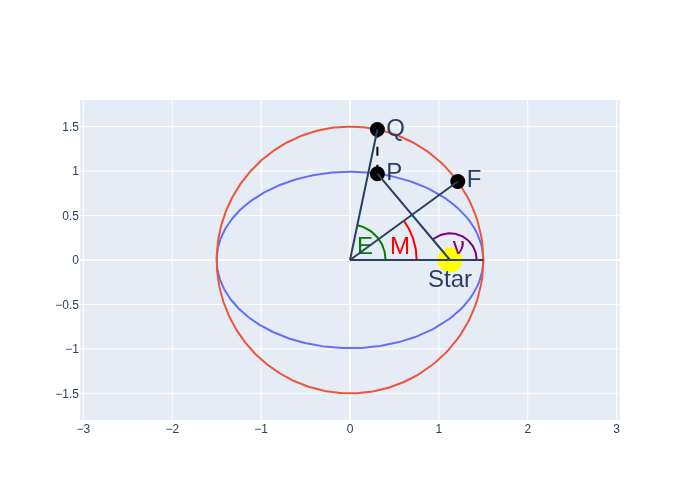
Imagine a circle with radius $a$ centred at the origin.
Mean Anomaly
Consider a hypothetical planet completing a full orbit in the same time period $T$ as our real planet on its elliptical orbit.
This hypothetical planet has constant angular speed, described by:
\[M(t) = \frac{2 \pi t}{T} \tag{3}\]The mean anomaly $M$ is the angle from the origin between the periapsis and the point $F$ on the imaginary orbit for given $t$, when $t=0$ at the periapsis.
Eccentric Anomaly
Take the point $P$ on the ellipitcal orbit, where the planet actually is at time $t$, and project upwards to the imaginary circle at point $Q$.
The eccentric anomaly $E$ is the angle from the origin between the periapsis and point $Q$.
True Anomaly
True anomaly $\nu$ is simply the angle from the star between the periapsis and the planet’s real position on the ellipitcal orbit at time $t$.
Computing eccentric anomaly from mean anomaly
Kepler found the below equation linking the mean and eccentric anomaly:
\[M = E - e \sin E \tag{4}\]So to animate our elliptical orbit with Kepler’s Second Law, we can solve for $E(t)$ to find where the planet should be on the hypotehtical circle, then project straight down until we meet the ellipse.
However, there is a problem. The above formula cannot be solved for $E$ in closed form. Enter: Newton’s iterative method for finding the root of an equation.
We can rewrite the above equation to
\[f(E) = E - e \sin E - M \tag{5}\]which turns the problem into a root finding problem - we can find $E$ from $M$ where $f(E) = 0$.
Let’s visualise this equation graphically. We can graph $f(E)$ for given values of $e$ and $M$. Here, $e = 0.7$ and $M=3$:
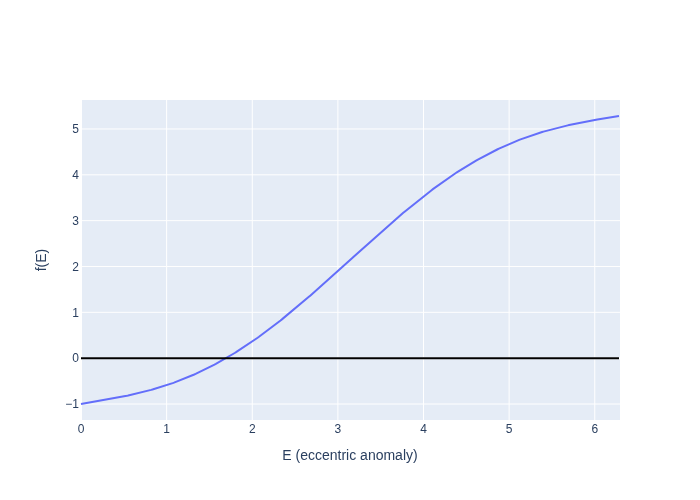
Then we take an initial guess. For us, a reasonable first guess is $E_0 = M$. Using the below equation, we can refine our guess to find the value of $E$ where $f(E) = 0$:
\[E_{n+1} = E_n - \frac{f(E_n)}{f'(E_n)} \tag{6}\]Let’s understand what we’re doing here. The numerator, $f(E_n)$, tells us whether we’re above or below the root, and by how far. The denominator tells us the gradient of the curve at this value of $E$. Looking at the curve, we know the gradient will be shallow far from the root and steep close to the root. When the gradient is shallow, the denominator will be small, so the step from $E_n$ to $E_{n+1}$ will be large, and vice versa when the gradient is steep.
We can substitute $f(E) = E - e \sin E - M$ and $f’(E) = 1 - e \cos E$ (knowing that the first derivative of $e \sin E$ is $e \cos E$) to write the equation in terms that we can calculate:
\[E_{n+1} = E_n - \frac{E_n - e \sin E_n - M}{ 1 - e \cos E_n} \tag{7}\]For our purposes, only 5 iterations of the above formula will give a value of $E$ so that $f(E)$ is extremely close to $0$.
We can then derive cartesian coordinates of the elliptical orbit using the below equations:
\[x = a \cos E \tag{8}\] \[y = b \sin E \tag{9}\]And drawing these coordinates in discrete time intervals gives the below animation, showing Kepler’s Second Law in action.
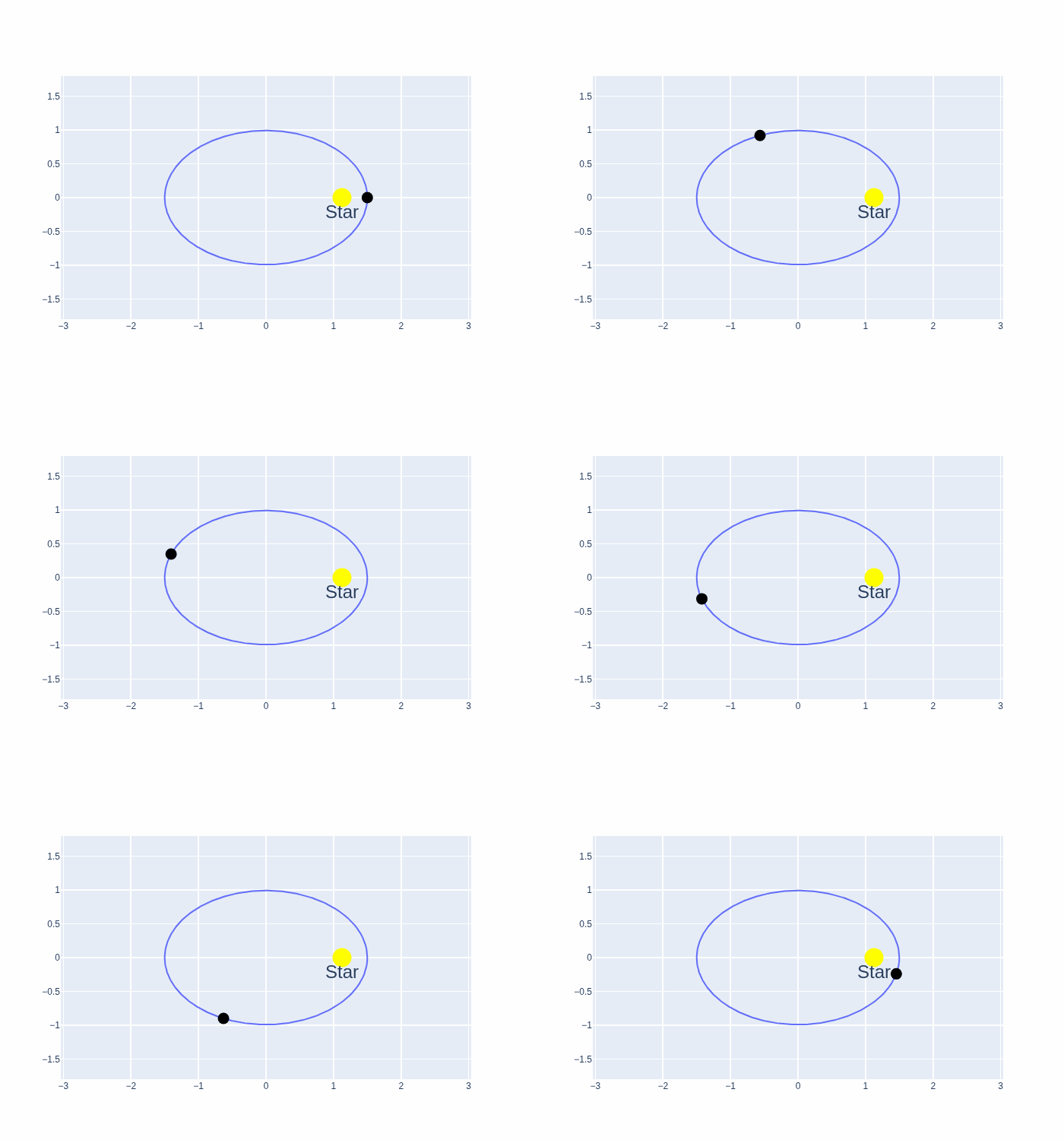
The object has an elliptical orbit around the star, moving quickly near the periapsis and slowly near the apoapsis.